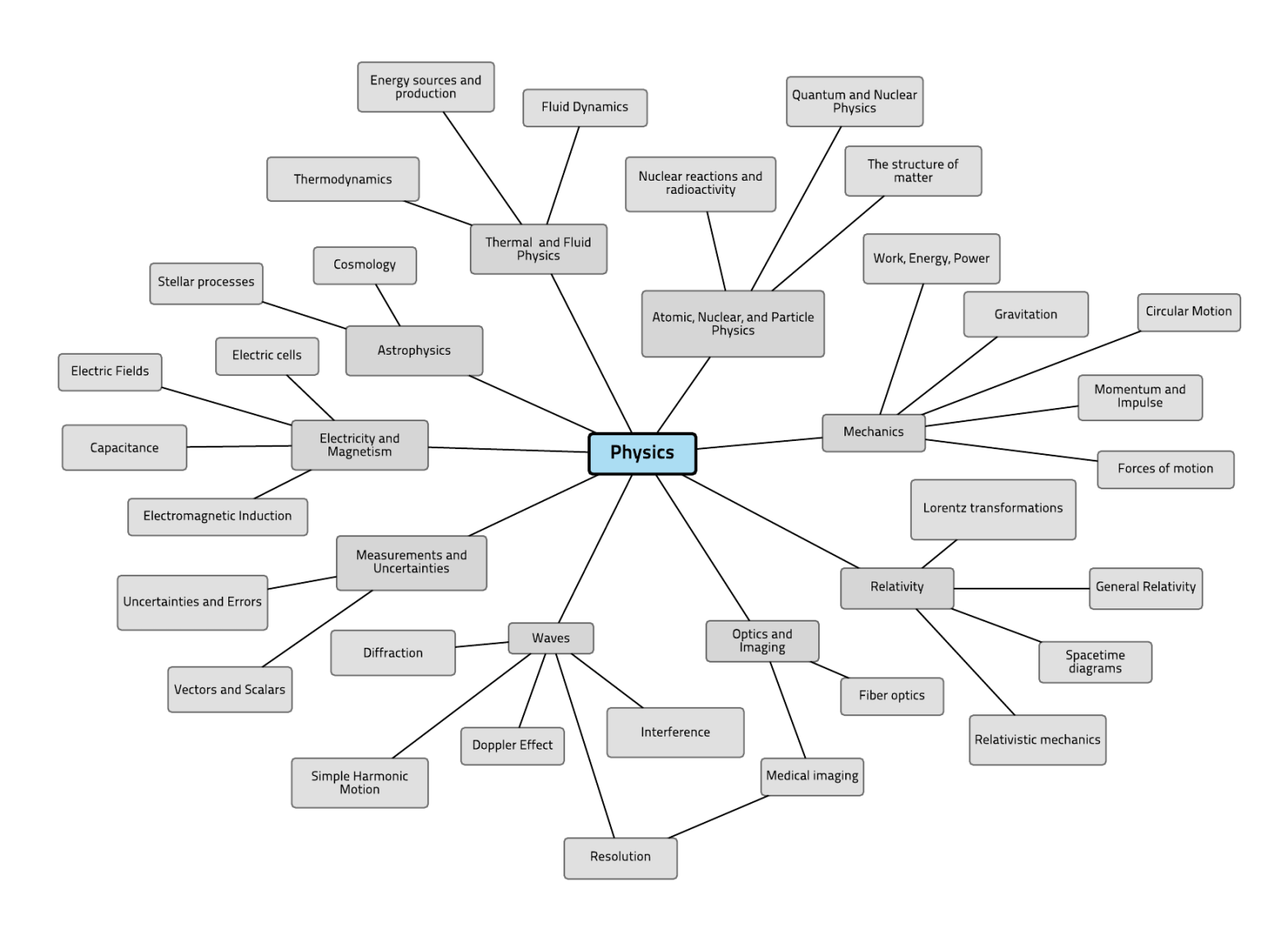
The best thing about physics is its universality, there can never be a finite number of ways in which one can explain anything about this vast subject. in this article we are going to understand this subject by examining its branches and involvements.
Branches of physics
Although the division of this subject can not be restrained to one or two branches but let’s not be that professional.
So, let’s try to classify this subject for a student and as a student.
The following maps shows the classification of physics on different basis
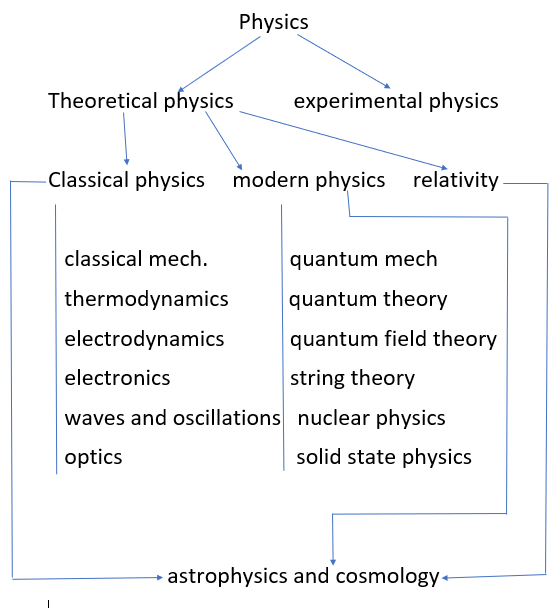
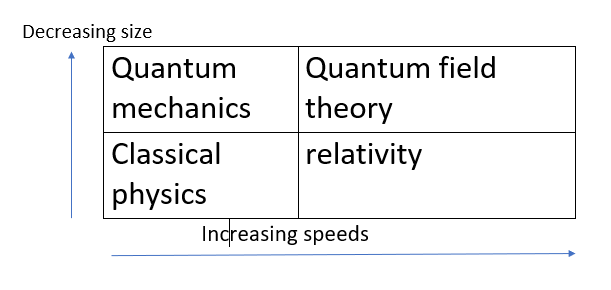
These are different ways to classify physics on different grounds but looking all these is quite confusing so let’s try to create a uniform distribution of physics which summaries all the maps shown above.
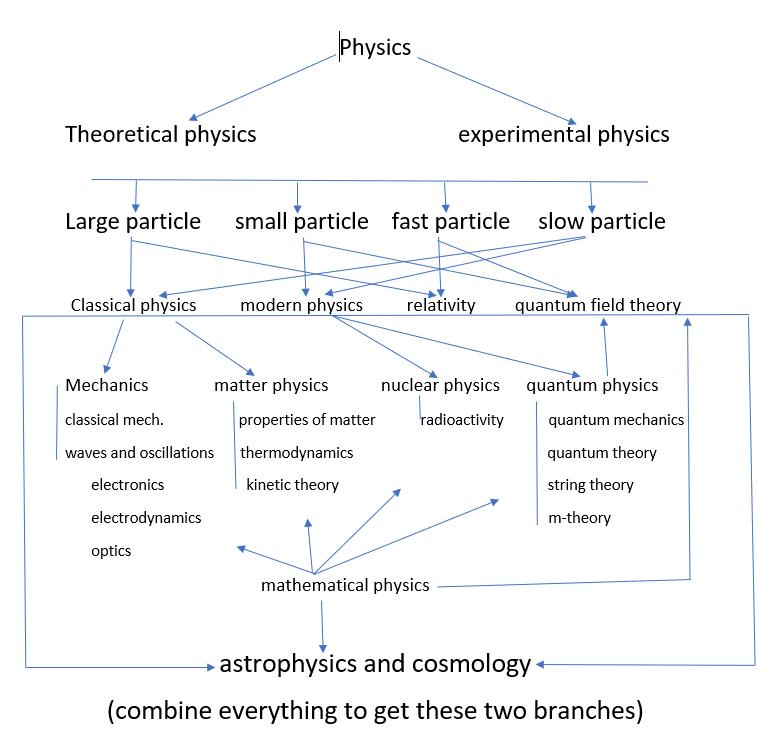
The map given above is just a combination of the former given two maps and also summaries the two different aspects of division of this subject.
As the map suggests there are mainly two universal branches of physics i.e. theoretical and experimental/applied
The theoretical physics is the part of physics in which we study, analyze and modify the basic principles of physics and later on we work on giving such basic principles. On the other hand, the second branch of physics is the applied physics which basically works on the principles provided by the theoretical physics.
The theoretical physics is again classified in four types on the basis of combination of size and speed of the object being studied, here small size refer to the sizes comparable to the size of atoms and molecules and high speeds refer to the speeds comparable to the speed of light. On this basis theoretical physics can be classified into four parts that are listed and each the part is further more classified on the basis of field it covers viz.
electronics- the study of semiconductor electronic devices.
optics- the study of light and its nature.
electrodynamics-the study of of causes and consequences of current generation.
classical mechanics- the study of every type of motion, its causes and systems working due to those causes.
Etc.
And in every branch and field of physics there is always requirement of mathematics to represent a process in a visual or formulated form this requires the use of mathematical principles to prove and express the physical phenomena. Hence the mathematical physics is branch that has equal significance in every branch of theoretical and applied physics.
Next there comes a branch of physics that deals with the celestial objects and their nature which has the use of every single physical principle in it, that’s why it is mentioned on the map that combine everything and we get a branch called astrophysics and cosmology.
Involvements of physics
From the very beginning there has been a single objective of physics and that is to find the ultimate truth behind everything, and when we say everything, we can think by ourselves that what is the range of involvements of physics in our life. If saying philosophically, we can say that our life is not possible without physics. And that is also depicted by the maps we used above. If we take look on the names of the fields that are covered by the branches of theoretical physics then we can understand that if our life is like the soil of a farm then physics is like the branches of the tree of truth in that soil.
The involvements of physics in our life is studied in the applies physics part, in that part we use the basic principles of physics and apply them in our daily lives to make life easier and better.
On going deep we can see that most of the study of physics in the engineering courses is applied physics because of which it reflects the professional nature of that field of study.
 the physicsVesre